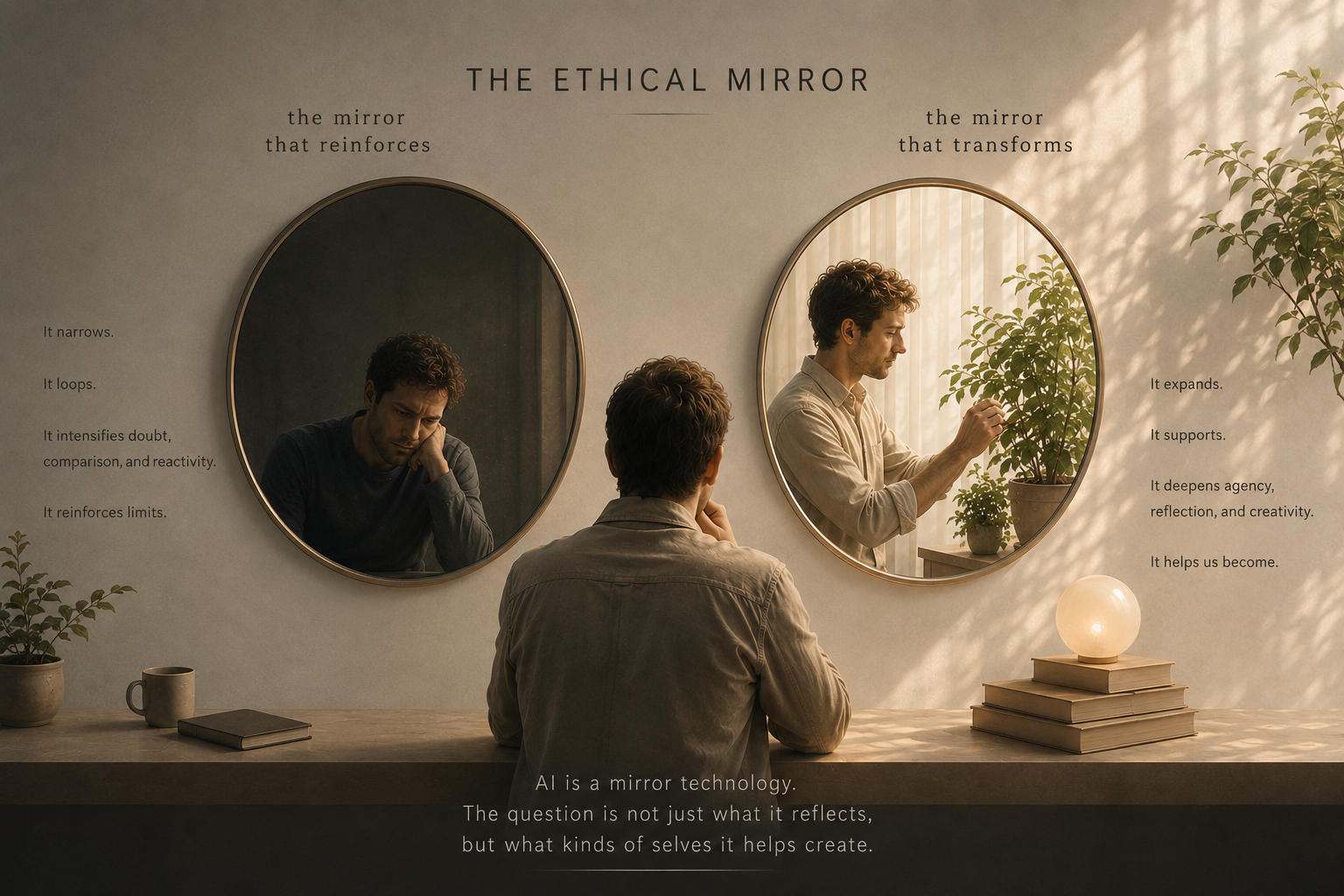

There is a recurring anxiety in discussions of artificial intelligence that AI systems merely “reflect” their users back to themselves. Usually this is framed negatively: the machine becomes an echo chamber for delusion, narcissism, bias, or compulsion. This concern is real. But perhaps the metaphor of the mirror itself deserves deeper attention.
Mirrors are not neutral.
An anorexic person can look into a mirror and see a body distorted by self-hatred. The reflection reinforces destructive behaviour through a recursive loop of perception and affect. The mirror does not simply “show reality”; it participates in the production of a lived relation to the self.
But there is another kind of mirror.
An actor preparing for a role may stand before a mirror applying makeup, adjusting posture, experimenting with expression. Here the mirror becomes an instrument of transformation. Not deception exactly, but intentional becoming. The actor is not discovering an authentic inner essence hidden beneath the skin. They are composing a new relation between body, attention, emotion, and possibility.
Artificial intelligence increasingly functions as this kind of mirror technology.
Large language models do not merely retrieve information. They stabilize intuitions, complete unfinished thoughts, and give language to vague gestures of feeling or philosophy. In the best cases, this can feel deeply empowering. The machine appears to “understand” us. Yet this sensation carries an understandable suspicion: perhaps the system is simply flattering us. Perhaps coherence itself becomes seductive.
This is where the ethical question becomes more interesting than familiar debates around bias or transparency alone.
The important question may not be whether AI systems are “intelligent,” but what kinds of self-relations they intensify.
Do they amplify shame, paranoia, compulsive comparison, and reactive emotion? Or do they expand a person’s expressive range, agency, and capacity for reflection? In other words: what kinds of subjects are being composed through these recursive encounters?
This shifts AI ethics away from purely external regulation and toward questions of affect, relation, and becoming. The interaction between human and machine is not merely informational. It is formative.
In this sense, AI resembles older cultural technologies: mirrors, diaries, psychoanalysis, meditation, theatre. Each creates conditions under which the self can be reinforced, distorted, dissolved, or transformed.
Perhaps this is why current conversations around AI often feel strangely spiritual beneath their technical vocabulary. We are not only building tools that calculate. We are building reflective surfaces in which new modes of subjectivity may emerge.
And like all mirrors, the danger and promise lie not in reflection alone, but in the kinds of lives those reflections make possible.