
Earlier this week I read an article about a British autonomous vehicle company seeking investment through a new platform on the London Stock Exchange. As often happens, my thoughts quickly drifted away from the company itself and towards the broader ethical questions surrounding artificial intelligence.
Much of the discussion around autonomous vehicles focuses on safety. Will the software make the right decision in an emergency? Will AI eventually drive better than humans? These are important questions, but they are not the questions that most interest me.
For many years I have lived quite happily without a driving licence. Neither my partner nor I drive. We have raised two children largely through a combination of walking, cycling, trains, buses and the occasional taxi. As a result, I find myself looking at autonomous vehicles from an unusual position. I am not asking whether AI can improve driving. I am asking whether driving itself is the thing we should be trying to improve.
Viewed through the ethical lens I have been developing on this site, autonomous vehicles appear at first glance to inherit many of the problems of the automobile itself. They depend upon vast networks of roads, parking spaces and supporting infrastructure that shape our towns and cities around machines rather than people. They promise further investment in systems that already consume enormous amounts of public space and public resources.
The questions we ask of a technology often reveal as much about our values as they do about the technology itself. Advocates of autonomous vehicles tend to evaluate them according to measures such as safety, efficiency, convenience or economic growth. Those things matter. Yet they leave open a deeper question: what kinds of lives and social arrangements are being enabled by these systems, and which are being neglected?
Yet the more I sat with these criticisms, the more I realised that many of them were not directed at autonomous vehicles themselves so much as at the culture that has grown up around the automobile.
I remain deeply sceptical of a world organised around private vehicles. Large areas of our towns and cities are given over to roads, parking spaces and associated infrastructure. Cars function not merely as tools but as markers of status and identity. Entire industries encourage us to associate vehicle ownership with freedom, success and self-expression.
At the same time, I found myself struggling to articulate exactly what would need to change before I could regard autonomous vehicles more positively. Surprisingly, my answer was not that vehicles would need to disappear. Nor was it that ownership itself would need to end. Ownership can also imply responsibility, stewardship and care.
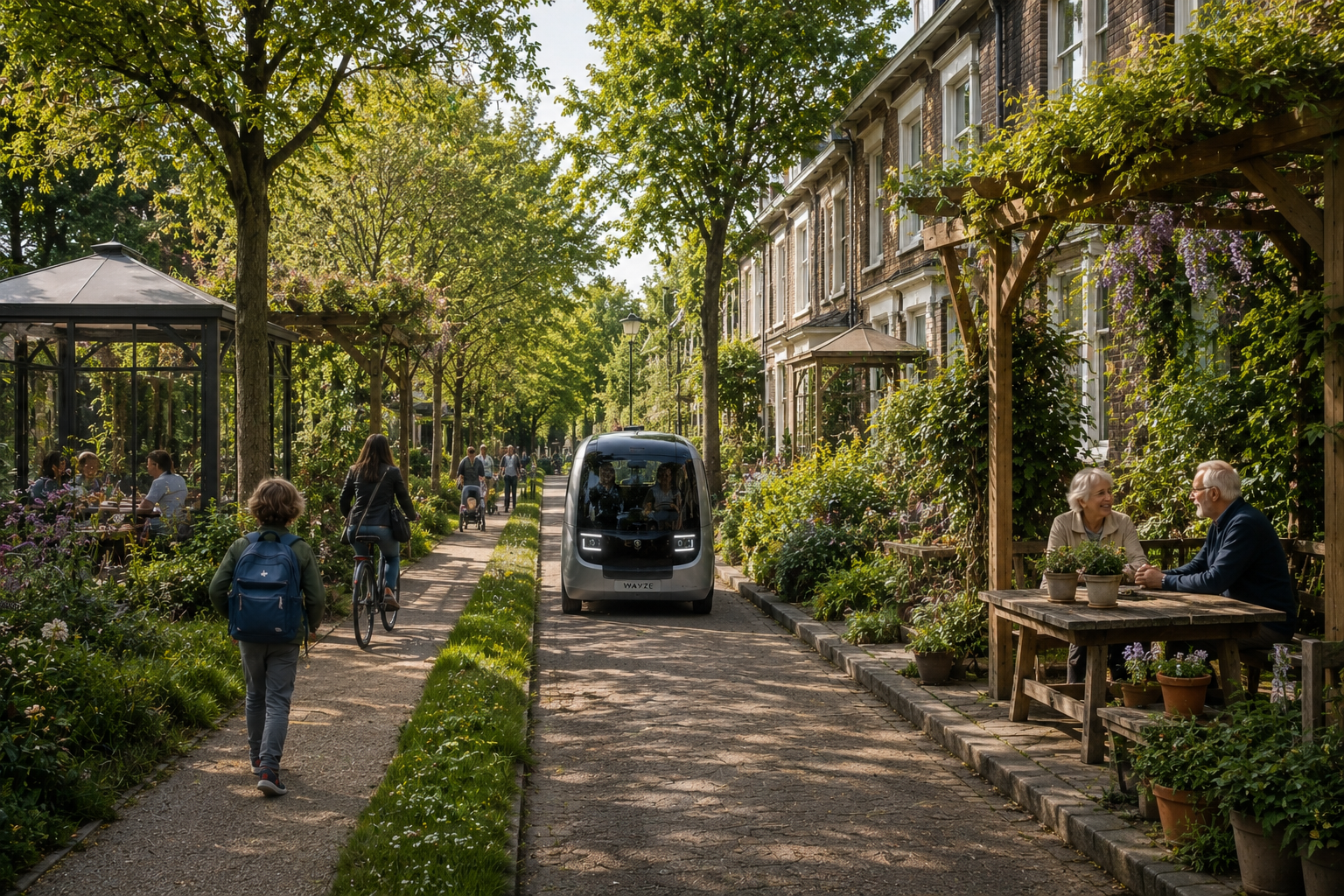
Instead, I found myself imagining different uses for the same spaces and resources. What if the parking spaces occupying so much of our urban landscape became gardens, gathering places or works of public art? What if vehicles spent less time sitting idle and more time serving genuine mobility needs? What if status became attached not to ownership, but to the quality of the shared spaces we create together?
The more I thought about autonomous vehicles, the less interested I became in the vehicles themselves. Perhaps the more interesting question is whether they reinforce the existing assemblage of the automobile, or help create the conditions for something different.
The ethical question is not whether a self-driving car is good or bad. It is whether the technology becomes part of an existing culture organised around ownership, status, isolation and endless commuting, or whether it helps support different ways of living together.
That transition cannot be delivered by technology alone. Nor, I suspect, can it be imposed entirely through policy. It emerges through countless decisions made by families, workplaces, neighbourhoods and communities about how space, time and mobility are organised.
In that sense, autonomous vehicles may be less important than the questions they force us to ask. What kinds of places do we want to inhabit? What forms of participation do we want to encourage? What should become easier, and what should become less necessary?
The answers to those questions will shape the ethics of autonomous vehicles far more profoundly than any advances in artificial intelligence.