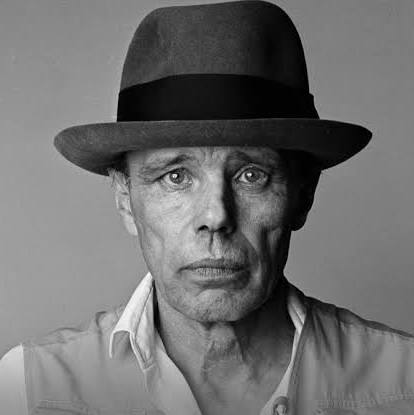

Joseph Beuys has been a recurring presence in my intellectual life for nearly two decades. Not always in the foreground, and not always comfortably.
I first encountered Beuys almost by accident while on a working holiday in London in 2002. Tate Modern was hosting a major retrospective of his work and, not knowing anything about him, I wandered in out of curiosity. I left enchanted. There was something uniquely expansive about the world his work opened up: shamanism beside politics, natural history beside performance, myth beside pedagogy, all carried through strange and affectively charged materials — fat, felt, honey, copper, basalt. I had never encountered an artist who seemed to treat thought, matter, symbolism, ecology, and social life as existing within the same field of practice.
Years later, as my studies in political philosophy and aesthetics became more focused, I found myself returning to Beuys through a different doorway. His ideas around “social sculpture,” participation, and creativity as a transformative social force began to intersect with my academic interests in political representation, ecology, and collective life. I became especially interested in his later political and ecological works, and in his founding role within the early German Green movement. What had initially captivated me aesthetically began unfolding into a deeper set of philosophical and political questions.
For a long time, however, I resisted bringing Beuys back into my work directly. Partly because his work can feel overwhelming in its totality: artist, mythmaker, activist, teacher, mystic, provocateur. But also because I came to suspect that the literature surrounding Beuys had reached a kind of saturation point. I worried that further engagement might amount merely to retracing already well-worn paths through an immense and heavily interpreted body of work. At times, it felt easier — and perhaps more intellectually responsible — to carry forward only the questions his work had opened for me, rather than returning to Beuys himself as a central figure.
At the same time, returning to Beuys also meant returning to an earlier version of myself: an academic project interrupted by emigration, precarity, shifting responsibilities, and the practical demands of adult life. For years, I experienced that interruption less as a transformation than as a kind of unfinishedness.
Only recently have I begun to see that continuity remained present beneath the surface. Revisiting my earlier writing on Beuys, I was struck by how many of the concerns that animate my current work were already latent there: ecology, participation, affect, ethics, embodiment, technology, and the shaping of social reality through creative practice. What I once experienced as a departure now feels more like a long unfolding.
My earlier work focused particularly on Beuys’ later political and ecological projects, especially 7000 Oaks. I was interested in the way Beuys treated art not as the production of isolated objects, but as an intervention into the conditions of collective life. His concept of “social sculpture” proposed that creativity was not restricted to artists or institutions, but was a fundamental human capacity capable of shaping politics, ecology, economics, and everyday existence.
At the time, I approached these questions through political theory, psychoanalysis, media archaeology, and aesthetics. I was especially interested in the tension between Beuys’ historical embeddedness and his attempts to exceed or transform historical determination. Critics such as Benjamin Buchloh saw Beuys as obscuring historical reality beneath myth and charisma; admirers often treated him as a quasi-messianic figure beyond critique. My own instinct was always to work somewhere between these poles.
That instinct remains.
I continue to believe Beuys matters, not because he offers a ready-made doctrine for contemporary life, but because his work opens difficult and unresolved questions:
How do people meaningfully participate in shaping collective reality?
Can creativity operate politically without collapsing into spectacle or branding?
What forms of healing or mourning are possible after historical catastrophe?
How might ecological thinking transform not only policy, but consciousness itself?
These questions feel newly urgent in the context of artificial intelligence and planetary computation.
Much of my current work revolves around what I increasingly think of as an ecology of linked practices: voice work, writing, ethics, cooking, contemplative practice, technological experimentation, and philosophical inquiry. Rather than treating these as separate domains, I’m interested in the ways they fold into one another and alter capacities for attention, participation, and relation.
In this sense, returning to Beuys has not meant reviving an old project unchanged. Instead, his work has become one important thread within a broader investigation into affective ethics, participation, and human becoming under technological modernity. One of the enduring insights I continue to draw from Beuys is his insistence that creativity is not the exclusive domain of professional artists, but a fundamental human capacity. His famous phrase “everyone is an artist” was never simply a slogan about artistic production; it was a claim about the possibility of shaping social and personal reality creatively and consciously. The artist, in this expanded sense, becomes the sculptor not only of objects, but of their own life and relations.
My recent projects – including experiments in perceptual retraining through virtual reality, reflections on AI as a form of ethical mirroring, and ongoing work around assemblage and resonance – all carry traces of Beuys’ influence, even where they depart from him significantly. I am less interested now in defending Beuys than in composing with him: using his work as a generative interlocutor while remaining attentive to its limitations, contradictions, and historical conditions.
I also find myself increasingly drawn not only to Beuys’ explicit theories, but to his mode of practice itself: the way he blurred boundaries between pedagogy, conversation, action, administration, symbolism, ecology, and everyday life. His work suggests that thought does not emerge solely through isolated contemplation, but through participation in material and social processes. Equally important is the implication that a life itself may become a site of composition: not in the sense of self-branding or aesthetic performance, but as an ongoing ethical and creative practice of participation in the world.
That insight has become central to my own approach.
The writings gathered here are therefore not intended as a definitive interpretation of Beuys. They are better understood as notes from an ongoing encounter – one that spans academic research, personal reflection, technological experimentation, and practical life. Some pieces will be historical or theoretical, others more speculative or autobiographical. Together, they trace an attempt to understand how aesthetic practice, ethical life, and technological modernity might still be composed otherwise.
Or, in a phrase that increasingly feels appropriate to my work as a whole: this is part of an ecology of linked practices.